Władysław Strzemiński is one of the most important figures of the twentieth-century European avant-garde, a brilliant painter, and an outstanding art theorist. Written toward the end of his life, his most vital theoretical work, “The Theory of Vision”, became the foundation of modern thinking about the image and remains a point of reference in academic debate to this day. Strzemiński conducted a revolutionary analysis of how humans look at the world. He demonstrated that vision is not a fixed biological process, but something that constantly evolves alongside the development of civilization.
Unism became the pivotal concept in his system. Strzemiński assumed that the history of art strives for the complete purification of the image from any external elements, such as narrative, literature, or the illusion of space. He held the view that the evolution of human visual consciousness is strictly linear and materialistic. The eye is not a permanent organ, but a biological mechanism that learns to see differently under the influence of external stimuli, namely changes in living conditions and the development of civilization. In this view, the environment and technological progress dictate the conditions of perception. A person of the industrial era, surrounded by machines and industrial architecture, sees the world fundamentally differently than a person from the cave or feudal eras.
Crucially, Strzemiński believed that this evolution does not occur uniformly across society. The engines of change are isolated avant-garde geniuses, such as Kandinsky or Malevich, who are the first to shatter the wall of existing perception and formulate new plastic principles. The rest of culture, led by other creators and audiences, constitutes merely a technological peloton. The task of this peloton is to mechanically absorb and catch up with the leaders’ discoveries as socio-economic development equalises the civilizational level. For Strzemiński, pure abstraction is therefore the ultimate biological product of material progress, where the history of the eye ends the moment it becomes independent of nature and confines the image within its own physical form. The presented text constitutes a record of a precise polemic with this materialistic paradigm, countering it with the theories of Conscious Abstraction.
Cybernetic or Conscious Abstraction stands in categorical opposition to such a framing of the matter, demonstrating that “The Theory of Vision” retains its truth validity exclusively within the realm of figurative art and the non-objective world, but not in pure abstraction. Yet, what truly is the non-objective world? Is it not an invented, fantastical environment created by the artist, meaning the very same world as ours, but reduced to two dimensions? Such a reality was already described in the book “Flatland: A Romance of Many Dimensions”. Strzemiński behaves exactly like the inhabitants of that two-dimensional world. He locked the image within its own physical plane of the canvas and declared it the end of history, claiming that the eye, purified of the illusions of nature, is meant to see only this flat materiality.
Meanwhile, Conscious Abstraction does exactly what the Sphere does with the Square in Abbott’s novel; it breaks free from the material plane. It shows that the rejection of figuration on canvas does not serve to lock oneself within a flat unism, but is the only way to encode multidimensional, non-physical, and conceptual structures upon that plane, structures that exist beyond the reach of the biological eye, within our mind. The third dimension in Flatland is the exact equivalent of a conceptual dogma in Conscious Abstraction; it indicates a different perspective and an alternative world. Different, because impressionability constitutes only a part of our vision, and there still exist logical thinking, our experience, and reflections that form this overarching dimension. Pure abstraction must therefore base itself on impressionability and the registration of visual stimuli, but parallelly on a complex conceptual relationship. Its foundation is the evolutionary development of abstract thought. Otherwise, it would not be a “Theory of Vision”, but a “Theory of Looking”, and thus Strzemiński’s concept is mistaken. For abstraction, content is just as indispensable as the visual side itself; otherwise, we become prisoners of Flatland.
The evolution of abstract thinking is not linear; rather, it responds to the existential questions that trouble humanity. Only today’s research into consciousness and the scientific analysis of ancient texts allow us to cast new light on this process. A crucial insight into the mechanism of the development of non-physical structures is provided by modern biblical scholars. When the confessional and religious layers are stripped away, the Bible proves to be an excellent document of the evolution of the human conceptual apparatus. These conclusions are confirmed by the research of Professor Maciej Majewski, which illustrates the journey of ancient Israel from simplified tribal structures to an advanced metaphysical world.
The oldest core centers around the figure of Moses and the Exodus from Egypt, which in historical terms was at most the escape of a marginal tribal group, likely unnoticed even by the pharaohs’ administration. Yahweh functions there as a clan god, one of many existing in the pantheon of that time, and the glue of this gathering becomes the legal code delivered by Moses. The Decalogue, which in the older Egyptian culture functioned as a collection of spells from the Book of the Dead or as a set of advice for officials, was transformed in the proto-Israelite culture into a rigorous legal system. At this stage, narratives about the flood or the paradise Garden of Eden do not yet exist in the texts.
A rapid evolutionary leap in abstract thought occurred only during the Babylonian captivity, forced by an existential crisis and a polemic with the more powerful culture of Mesopotamia. There, the development of abstract thought was at a higher level, as evidenced by the borrowing and reworking of myths about the flood and the creation of the world. A pressing need then arose to answer the question: why is the world the way we see it? The leaders of Israel had to explain why the chosen nation was defeated, where the suffering of the righteous stems from, and what happens to a person after death. These problems forced the human intellect to develop entirely new cognitive tools. The impulse was not technological progress or the physical training of the eye, but the necessity to define a non-material reality. The problems of theodicy, meaning the justice of God in the face of evil, cannot be described through figurative literalness. It is then that the assimilation of Babylonian thought and the deep reworking of foreign myths occur, an example of which is the adaptation of the Babylonian Enuma Elish myth in the Book of Genesis, transforming it into a polemic of one God versus many gods. We see, therefore, that even then the battle was fought at the level of pure mental concepts, which could not be accounted for in “The Theory of Vision” because they did not manifest in the art of antiquity, but in its writings.
The emergence of non-figurative art is deeply connected to the world of mysticism, the occult, and philosophical schools such as theosophy, and subsequently anthroposophy. The purification of the image postulated by Strzemiński does not occur because of an evolutionary training of the eye, but due to the evolution of non-figurative thinking. Twentieth-century philosophical currents drew directly from this centuries-old tradition of conceptual analysis, and it is precisely within this process that the true roots of abstract thinking and the birth of abstraction itself must be sought.
The logical error of “The Theory of Vision” is further exposed by the creators of non-figurative art themselves: Kandinsky, Mondrian, and Malevicz. The culmination of their search is the end of pure non-objectivity in Kandinsky and Mondrian, as well as a complete departure from Suprematism by Malevicz. Official art history capitulates before this fact to this day, calling their late works abstraction, which is a blatant terminological inconsistency. For how can the grid of New York streets in Mondrian or the biological amoeba forms in Kandinsky be considered pure abstraction? Following this flawed logic, we would have to accept that Monet’s haystacks did not represent reality because they were merely a laboratory record of the physics of light, or that the wild colours of the Fauves detached themselves from matter, while they were only the autonomisation of a sensory stimulus. Both the Impressionists, the Fauves, and the alleged geometric abstractionists moved along the same line; they altered the degree of simplification and stylisation of form, but their point of reference remained deeply rooted in the physical world. Why did these precursors, at the twilight of their lives, suddenly return to biological forms, city street grids, or reject non-objective art entirely? The answer is singular: without content, art becomes exclusively ornament, and ornament is subject to the rigid rules of mathematics. The number of combinations of purely formal elements is a finite number, and at a certain point, it simply begins to repeat itself.
Considering this situation, within the logic of Flatland, one can say that such art lacks a third dimension. The birth of modern non-figurative art was not the result of a revolutionary technological and physical change, as Strzemiński wanted, but arose from a deep need to answer questions to which the material world has no answers. And this flat, non-objective type of art will never answer them. We do not need an artificial non-objective world, but an abstraction contained within both the visual structure and its deepest content.
“The Theory of Vision” completely fails to account for this because it focuses solely on the historical evolution of form, through which it attempts to enclose it within an easily classifiable linear development. The world of abstract thought, however, does not develop linearly; it continuously presents the human cognitive apparatus with new scientific and existential challenges. The permanence of the architecture of the human mind is confirmed by modern empirical observations. I was a direct witness to a discussion between two of my friends, engineers from India employed in the high-tech sector. They were discussing the concept of an avatar, the earthly incarnation of a deity that descends into the material world to restore cosmic order. One of them, representing the orthodox perspective of Mumbai, denied avatar status to the eighteenth-century mystic Swaminarayan, arguing purely structurally; since evil, corruption, and the age of darkness still persist in the world, and human nature outside a closed community has not changed, the cosmic order was not broken. The second, rooted in the tradition of Gujarat, countered this objection by stating that divinity manifested itself not through the physical extermination of sinners, but through an internal, moral revolution in the hearts of people and the abandonment of violence.
The fact that modern scientists, operating daily with the most advanced technology of the twenty-first century, engage in the exact same, precise theological dispute over the definition of the absolute and regional influence of a deity on history that the apostles fought two thousand years ago after the death of Jesus, proves a vital thesis. The development of the material base, machines, and technique does not change the matrix of human abstract thinking. The human brain possesses a fixed architecture for organising non-material ideas. The assumptions of “The Theory of Vision” completely omit this fact, which is why its author was unable to touch the essence of abstract art. Pure abstraction remains a reliable, objective, and universal record of thought structures that are just as real as the physical world. Strzemiński treated it as a common, mechanical mutation of sensory reality and the biological culmination of the development of the material base. Meanwhile, Conscious Abstraction is an entirely intellectual process describing content unattainable by the figurative apparatus. The material trace and the biological determinism of the eye have no place here. Conscious Abstraction grows out of an entirely different reality, from the world of thought structures, not from physical matter and the evolution of machines.
An equally profound logical error in “The Theory of Vision” reveals itself in the way Strzemiński defines light itself. For the author of Unism, light is exclusively a physical wave, an external mechanical stimulus that strikes the retina of the eye and triggers a biological process. His entire fascination with afterimages, this key element of his late works, rests on pure physiology. An afterimage, after all, is nothing other than the fatigue of the eye, an automatic and involuntary chemical reaction of the receptor to the force of photons. Strzemiński thus reduces light to the role of a laboratory reagent, and the artist to the role of a seismograph recording the vibrations of behaviour.
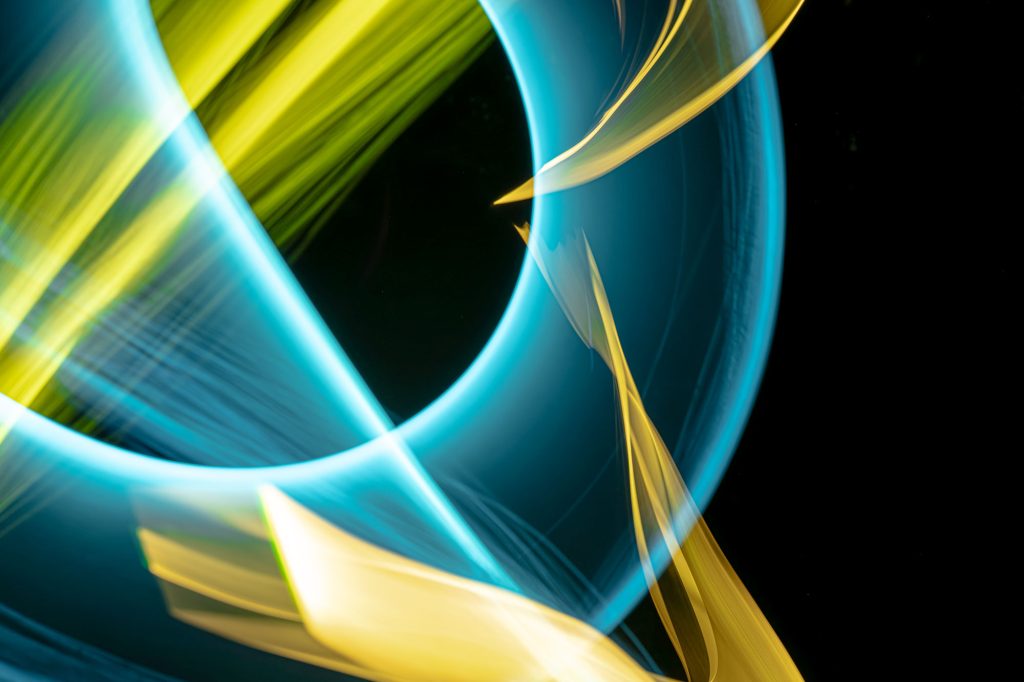
Conscious Abstraction, implemented through a rigorous practice of operating with light, performs a total reversal of concepts here, tearing the matter of light from the clutches of physiology and ophthalmology. This concept redefines the status of light; it ceases to be a stimulus that the eye receives, and becomes the primal building block that the mind bestows. Only during the execution process is this matter subjected to the rigor of conscious creation, though its nature never submits to total control, leaving its own understatements that constitute the subtle nature of light. Thanks to such a framing, it becomes an exceptionally defiant, yet autonomous carrier of a conceptual structure, rather than an afterimage on a fatigued retina. This presence is not confined solely to colour; it manifests in intensity across the plane and in tonal transitions. It is not about how the eye reacts to a flash, but about how to preserve and manifest a pure, non-physical dogma through a specific process. Light, as a material subordinated to theory, acts as a language, not as a physical battering ram striking the eye.
This directly redefines the concept of consciousness itself, which Strzemiński treated in a highly instrumental manner. For him, it was merely an intellectual filter, a kind of evolutionary overlay on the brain whose sole task is a more efficient organisation of the visible world, adequate to a given era. Consciousness was meant to assist humans in organising the surrounding matter and nature. In this place, “The Theory of Vision” unwittingly contradicts itself. In striving for a non-objective unism, one cannot simultaneously utilise a consciousness trapped in the organisation of matter. Strzemiński attempts to use a partial sensation and a biological impression to describe something that is allegedly meant to be free from matter. This is a logical deadlock.
Conscious Abstraction completely rejects this mechanical rupture. Human consciousness is not a fragmented filter; it constitutes an inseparable phenomenal whole and an access structure that jointly construct subjectivity. Although experiences and beliefs differentiate each of us, at a fundamental level, the access structure allows us to universally operate with concepts such as time, memory, or being. This occurs because access consciousness always maps them based on universal relationships and changes, rather than the temporary biology of the eye. For “The Theory of Vision”, this level is completely unattainable, as non-material concepts cannot be sifted through a simple intellectual filter.
Therefore, in the creative process, consciousness must be engaged in its phenomenal entirety. Art based on the unistic clearing of the plane ends in cognitive emptiness; it generates no questions, leaves no room for the intellect, becoming a semantic dead end. Meanwhile, a visual record that relies on a structure of mystery and conscious understatement forces the mind of the receiver to exert effort. A true conceptual structure does not present itself on a platter; it requires deciphering. Conscious Abstraction assumes that the mind cannot be divided, and the work carries within itself an overarching content and dogma; the task of the receiver is to undertake a rigorous attempt to locate them within the matter of light.
Another deep division between both concepts concerns the very status of reality. Strzemiński remains a radical materialist, and for him, only one physical reality exists. The entire evolutionary process of visual consciousness boils down, in his view, to how man increasingly efficiently perceives, processes, and organises this material world upon the plane of the work. Conscious Abstraction stands on the exact opposite ground; alongside material reality, there exists a fully real, objective world of abstraction. The world of concepts, relations, thought structures, and dogmas is not a human invention or a fluid impression; furthermore, it possesses its own autonomous and inviolable architecture. This theory was not created for the needs of a new aesthetics or visual journalism. Conscious Abstraction does not decorate or interpret the world of thought; it is a rigorous process of its objective description. A visual record on a plane does not refer to the physical environment, but becomes a precise topography of a non-physical entity, mapped by means of the matter of light, which ultimately completes itself within the mind of the observer.
This ontological shift drastically redefines the role of the creator. In Strzemiński’s work, the creator is merely a constructor of form, a craftsman who builds a new, autonomous object on the foundation of visual evolution. In Conscious Abstraction, this role resembles rather the stance of a Renaissance person, uniting art with science and philosophy. This theory forces continuous development; there is no room for chance here, and executions rest upon the hard world of conceptual facts. Such a rigor absolutely eliminates creators who do not know what they want to convey, or helplessly surrender their work to arbitrary interpretation depending on where it is exhibited. It also puts an end to retrofitting ideology onto a finished image, to that empty chatter so prevalent in modern visual records. The description of time or being must always be coherent and embedded in objective symbolism. One does not construct form out of nothing for a pure aesthetic game or formal experimentation. The work is a reliable record of the conscious observation of the abstract world and an attempt at its precise description. The creator becomes an observer who, by means of a rigorous process and tools, records objectively existing non-physical structures.
The consequence of this is an entirely different status for the work itself. Strzemiński’s unistic image was meant to be a dead end for meanings, exclusively a flat plane covered in paint that refers to nothing outside itself. In Conscious Abstraction, the plane is a visual record, a document, and a reliable testimony to a specific structure of the abstract world. Even if at first glance this content appears unreadable, it must be present as a visualisation of the title, which clearly defines the subject of consideration or description. Such a work possesses an immense conceptual weight because it describes an actual extra-material reality. The lack of figuration is not a caprice here, but a scientific rigor; a non-physical world cannot be described with a physical object.
At this point, the axis of the polemic attains its final shape. Strzemiński believed that abstraction is a historical process of purifying the human eye to finally see the image itself in its pure materiality. The counter-position of Conscious Abstraction is total; abstraction is not a method of looking at an image, but a method of describing an objectively existing extra-material world. Evolution does not lead us to an unistic emptiness, but allows us to increasingly precisely map the architecture of human thought, concepts, and myth.
The final choice before which this clash places us does not concern the styling itself or the degree of simplification of form, but the status of truth in a visual record. We can remain within the safe boundaries of Strzemiński’s two-dimensional Flatland, treating the work as a laboratory afterimage on a fatigued retina and a mechanical product of material progress. Then, however, we condemn ourselves to cognitive emptiness and a finite number of formal combinations. Conscious Abstraction chooses the path of moving beyond this material plane. By restoring an overarching content to art and treating the matter of light as a precise language for describing non-physical reality, it redefines the status of the creator. The creator is no longer a craftsman training his own eye, but a conscious observer and chronicler of universal conceptual structures. In this framing, pure abstraction ceases to be an aesthetic experiment. It becomes a reliable and objective document of human thought, the only one capable of touching structures that exist beyond the reach of biological sight.