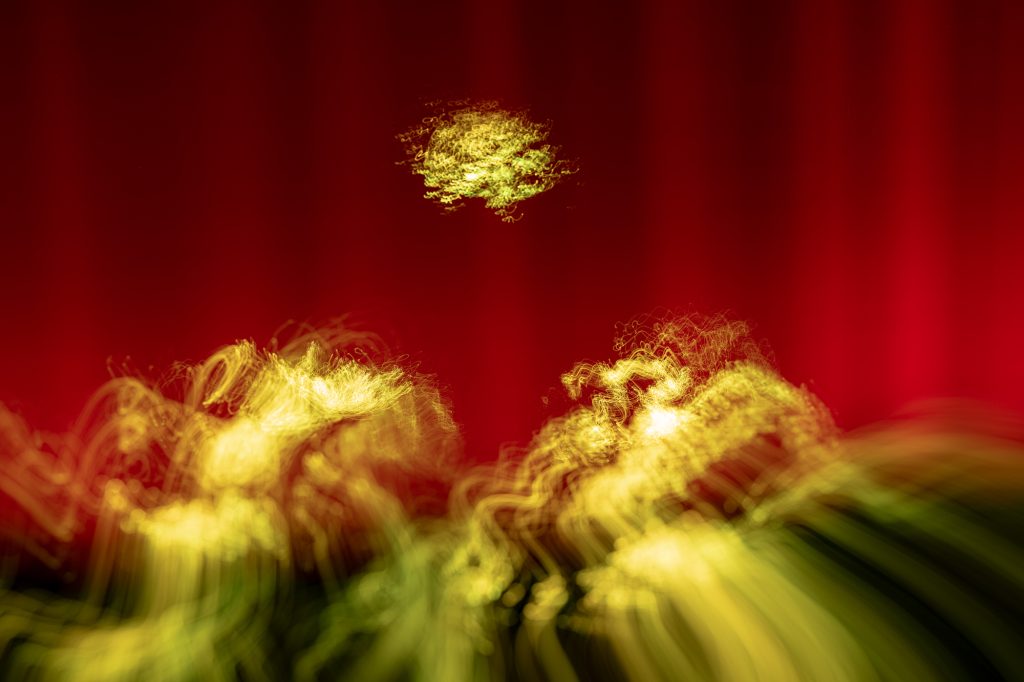
In the 1960s, conceptualism declared war on traditional art, proclaiming that painting or sculpture was dead weight and that only pure thought mattered. Artists traded their studios for desks, becoming administrators of ideas rather than their creators. In this new world, a work of art became an instruction manual, a chart, or a dry note. The concept was all that counted, so matter itself was pushed to the margins, treated almost as a shameful relic of the past that only hindered pure thought. For conceptualists, craft was redundant; if the idea is everything, its physical form loses all significance. This approach created art that severed its ties to matter, often becoming an intellectual, sterile tautology—a conversation art was having with itself. Artists stopped building and started merely describing. As a result, instead of creating concrete structures, they created a space full of intellectual emptiness, where the lack of operational discipline effectively killed any real agency.
Let us examine these assumptions through the prism of Conscious Abstraction. While conceptualism celebrated dematerialization, Conscious Abstraction focuses on precise construction, where every light is a code, not just a sign. Where they saw art as a self-contained, ill-defined idea, I see a toolset for describing dogmas that the language of figuration cannot bear. I seek neither tautology nor artistic administration in my work, but a philosophical understanding of a given abstract concept. Even “Art” is, for Conscious Abstraction, a concept that must be described using non-figurative symbols. I do not ask how to make it, but what it is and what definition lies dormant within it. One cannot create art without knowing what it is, just as one cannot build a building without knowing about materials, their processing, or the purpose of the object.
Let us break art down into its component parts. Is it painting, sculpting, or visual recording? No. You can paint rooms, carve headstones, and Instagram photos are just a record of daily life. Art is not an activity, paint, a chisel, or a tool. It is purely abstract concepts condensed into one. I divide them into five pillars, governed by a strict hierarchy: each subsequent point is built on the foundation of the previous one, making the objective primary and absolutely more important than the recognition of the environment:
- Objective: The absolute denial of utility. If an object has an application in daily life, it is not art. In Conscious Abstraction, stripping an object of its functional role is an act of liberating matter from its mundane purpose.
- Intention: Conscious direction of thought and work. It is not a coincidence, but a planned process in which the artist imposes their own vision onto matter. There is no room here for shamanic pretense that the work creates itself through the subconscious or some cosmic force. The artist is a conscious entity and must know what they are doing and why. They cannot hide behind a lack of knowledge regarding their own message or allow for arbitrary interpretation, for in such a case, they become merely a craftsman who has released a product without imbuing it with their own meaning. Without intention, we are dealing with an empty gesture, not a work of art.
- Style: An inalienable signature of the author, resulting from their life path and intimate perceptions. It is not decoration, but proof of authenticity—a trace that allows the creator to be identified even in the most abstract structure. We all think differently and interpret the same things differently; our opinion is valid as long as it rests on the foundation of truth. One cannot say the Earth is flat just because “I feel it”—that is not art, that is ignorance. But one can, relying on knowledge and analysis, pose the question of whether the components of the concept of eternity, which is infinity, have a beginning or not. Style is the way in which the artist carries out this intellectual operation, while remaining faithful to the facts and their own method.
- Visionary Nature: Art should not merely describe the world we live in, but be a tool that projects a future reality. Visionary nature is the ability to anticipate dogmas we cannot yet name, but whose structures we already feel. A visionary artist does not wait for trends; they construct concepts that will only become understandable to the rest later. Without this ability to transcend the horizon, art becomes only a conservative record of the present, not its driving force. This is not a trait of every artist, but it must be included in the definition, because such people have changed the face of art.
- Recognition of the Environment: A mechanism that allows art to live and evolve beyond the walls of the studio. It is the community’s agreement to recognize a specific construction as art, which opens the way to new languages of expression. However, this is not about creating “fads” that sell well. Such an approach might have been correct in the 20th century, but in the world of community we are creating today, it has no place. Art should provoke real intellectual unrest and force people to think, not merely fill space with objects intended to satisfy the buyer. In this context, recognition of the environment is a joint effort of understanding, not a transaction.
Note that none of these concepts is material, so they remain beyond the reach of figurative art. It is different, however, when we use the theory of Conscious Abstraction. It is this theory, thanks to its grounding in symbols, that allows us to develop art into such components and reassemble it on a plane. In this process, the medium does not matter; whether it is a work in the technique of Light Painting, sculpture, or painting, what matters is only that the process must take place in the mind, supported by philosophy, linguistics, and symbolism.
In the conceptualist movement, epitomized by Joseph Kosuth, art ceased to be the creation of objects and became solely the investigation of its own definition. According to this assumption, “art is art.” Artistic work was reduced to the role of an analytical message: a photo of a chair, the definition of a chair, and a physical chair side by side were meant to be sufficient proof that art is merely a tautology. In this view, art is “pure information,” a closed system that looks at itself in a mirror, examining its boundaries, only to ultimately conclude that there is nothing more to say outside the definition of art.
Conscious Abstraction rejects such “artistic administration.” We do not engage in examining our own reflection in the mirror, because art about art is a form of narcissism that strips creativity of any agency. The example of the “Teleportation” of Zbigniew Warpechowski perfectly exposes the weakness of this thinking. The artist, by announcing teleportation, builds nothing that would transcend the framework of art administration—they merely check whether the environment will accept their gesture as a fact. This is a closed circuit in which the artist becomes a shaman confirming the definition of their own agency, rather than a creator of structures.
While the conceptualist “investigates” the definition of a chair, I build a symbolic code that allows me to describe structures such as time, memory, or emotions. I am not interested in sterile information; I am interested in the construction of meaning. What would teleportation look like in Conscious Abstraction? The body is turned into pure information and thus destroyed, in order to recreate the human elsewhere based on that information. If, however, we become code, then in the process of transmission, it can be intentionally changed. On the other side, physically the same person appears, but with different beliefs or implanted memories. One can even change physical traits to perform rejuvenation, cure illnesses, or perform aesthetic procedures—so that the subject would never know of the interference and would always believe that “it was always so.” Conscious Abstraction thus forces us to understand that every thought-dogma carries consequences whose significance we must address. My works are not “art about art,” but a system for describing such dogmas and questioning their impact. Conceptualism plays with the definition of a chair, while Conscious Abstraction builds tools to understand what in our identity is still elusive—we do not ask if art is art, we use art to break the limitations of the human mind. If art is to be analytical, let it analyze the structure of thought, not its own shadow.
In the spirit of conceptualism, the striving for “neutrality” took the form of zero-aesthetics. Creators of this movement recognized that any visual attractiveness of a work posed a threat to the purity of the message. The work was supposed to look “boring” and inconspicuous—like office documentation, a chart, a map, or a typescript—so as not to distract the viewer with aesthetics. In this assumption, visuality was treated as “noise” that must be silenced so that the recipient would focus solely on the “intellectual fact.” Zero-aesthetics is, in essence, intellectual cowardice disguised in the costume of objectivity. Escaping into boredom is not “neutrality”—it is a surrender to the complexity of the world.
Conscious Abstraction rejects this false separation of form from content, where visuality is meant to be merely an ornament. Color, the structure of light, and visual density are not decoration, but integral elements of a logical system. Forcing the viewer into “boredom” in the name of so-called objectivity is just another form of authoritarianism—imposing on the recipient that the only acceptable path to understanding a work is intellectual asceticism. I choose the path of precise visual construction, because the most knowledge is contained in the space between symbols, where we must analyze their mutual relationship. Take, for example, the symbol of a heart and an arrow: each separately carries a different meaning, but their combination evokes in the viewer a memory that completes the understanding of this relationship and explains its consequences. If “aesthetics” is an operation on visible matter, then in Conscious Abstraction, I operate on it with engineering precision to extract the structure of meaning from it. My works are visually “dense,” because the reality I describe requires complexity, not minimalist sterility. I use visuality to show what no office documentation will ever be able to describe.