“There is no abstract art. You must always start with something. Afterwards you can remove all traces of reality. There’s no danger then anyway, because the idea of the object will have left an indelible mark. It is what started the artist off, excited his ideas, and stirred up his emotions.”
In May 1935, in his Paris studio, Pablo Picasso uttered words that for decades imprisoned thinking about abstraction within the cage of the material world. For the Spanish master, the creative process was an act of distillation and a ruthless stripping of reality from its external appearances, until the primal, figurative core was exposed. Picasso claimed that the artist is a slave to the impulse given by the object, and that it is impossible to escape the shadow of a table, a woman, or a guitar, because their idea leaves an indelible mark within the structure of the work.
This view rests on a profound delusion. It was convenient because, on one hand, it provided a market sanction for craftsmanship. It protected artists from accusations of charlatanism and gave critics an easy tool to evaluate the degree of material transformation. On the other hand, it served as an ideal alibi for the lack of an independent thought system. It exempted creators from the duty of designing a new reality from scratch, allowing them to modify the physical world into a non-objective one, and to build entire art movements on pure aesthetic intuition instead of intellectual rigor. Thus, they proved that Picasso’s argument was true for them. For he assumed that human creation is secondary to matter, and that the creator can only digest what is already given. Look at the work of late Kandinsky and Mondrian. The former painted invented biomorphic creatures, meaning he was still replicating the biological structures of the microscopic world, while the latter marveled at the street grid of newly built American cities, transferring pure urban planning onto the surface. In neither case can we speak of authentic abstraction, because both artists merely shifted their set of physical reference points. The pioneers of the new path had to make these mistakes; operating in an absolute conceptual vacuum and without any ready-made rules, they sought intuitive support in what the physical world suggested to them.
Picasso feared the vacuum. He believed that severing ties with the physical object condemned art to worthless formalism and pure decoration. The logical error of Picasso and the entire mainstream of the era lay in equating the concept of a material vacuum with a semantic vacuum. They dogmatically assumed that if there is no afterimage of the physical world within the frame, the sign loses its capacity for precise meaning, and the work automatically becomes a hollow ornament. The art world of the time completely overlooked the fact that abstraction does not have to be exclusively geometric reductionism. The mainstream failed to notice that there is an alternative attempt to record non-tangible registers, an intuitive pioneer of which was, for instance, Hilma af Klint.
Conscious Abstraction proves that the exact opposite is true. Human minds liberated themselves from the trap of materialism long ago in favor of pure dogmas and the creation of a mental world that describes our reality as rational beings far more precisely.
The theory of Conscious Abstraction proves that the starting point never needs to be a figurative, physical impulse. The creative process is born from a pure concept, from a philosophical dogma, and from an understanding of the conceptual structure itself. When we reject the necessity of translating material reality into a visual language, Picasso’s fears of drifting toward ornament completely vanish. From the very beginning, the fabric of the work is formed from autonomous symbolic elements, such as the pure emanation of light or relational arrangements of gradients. This process functions as a precise, extra-linguistic description of thought. The goal is singular: to investigate and describe mental dogmas, translating them directly into a visual structure that engages the viewer’s consciousness without the mediation of matter.
The historical absence of works representing peace is perfectly highlighted by curator Barbara Polla. While art history is flooded with paintings of battles, the pure state of peace remains almost invisible within it, or is reduced to a naive idyll. Any attempt to show peace through figuration always ends in falsehood. If an artist paints the table where a treaty was signed, a sleeping child, or a dove, they do not capture peace, but mere props. The table remains a piece of furniture, and the dove remains a bird. Exactly the same blind attachment to matter is evident in the way war is depicted. Picasso in Guernica could only speak of conflict through the pain of a torn, physical body. This is a logical error. War is not a material phenomenon, but a non-physical act of political coercion. Isolated shots on a border or a tank do not constitute war—they are merely mechanical tools for conducting war. Painting an explosion or a dying soldier is merely the recording of a local, biological consequence of a clash, not the visualization of a complex political, informational, or economic dogma. War and peace are invisible relational networks. Any attempt to force them into a material form always condemns the artist to using naive, literary anecdote, because the classical apparatus of representation seeks a physical core where nothing exists but a pure architecture of meanings.
This helplessness reveals itself completely in attempts to visualize contemporary customs or information wars, which lack a kinetic dimension, as well as in the century-long process of emancipation. Attempts to reduce social liberation to the image of a woman working as a steelworker or a miner—which the authorities of the Eastern Bloc countries offered us for decades—were merely a flattening of the idea to a physical attribute of labor. To truly encode these processes within the frame, one must first decompose them into their constituent parts within a conceptual system. Conscious Abstraction completely rejects material props. Instead, it develops an autonomous symbol for each component and introduces precise operators of relations between concepts. Only such a combination yields the philosophical and logical resonance that forces the recipient’s intellect to undertake an authentic logical operation.
At this point, a clear boundary also emerges separating Conscious Abstraction from the mystical pursuits of Hilma af Klint. The Swedish pioneer treated the surface as an illustration of a ready-made, external system of spiritual symbolism, which she allegedly received from higher beings. Being deeply embedded in anthroposophy and theosophy, she regarded the creative process as a dictation by angels. Consequently, what was her own revolutionary formal discovery, she surrendered to the domain of non-physical entities, turning art into a tool for achieving spiritual enlightenment. This misstep, however, does not diminish her role. As a pioneer building everything from scratch, she had the right to her own compromises with the spirit of the age. Conscious Abstraction does not reject her rebellion, but purges it of that metaphysical determinism. It does not seek external revelations nor does it illustrate ready-made wisdom diagrams. Instead, it builds pure, relational connections between intellectual concepts themselves, operating within the boundaries of human consciousness and logical rigor.
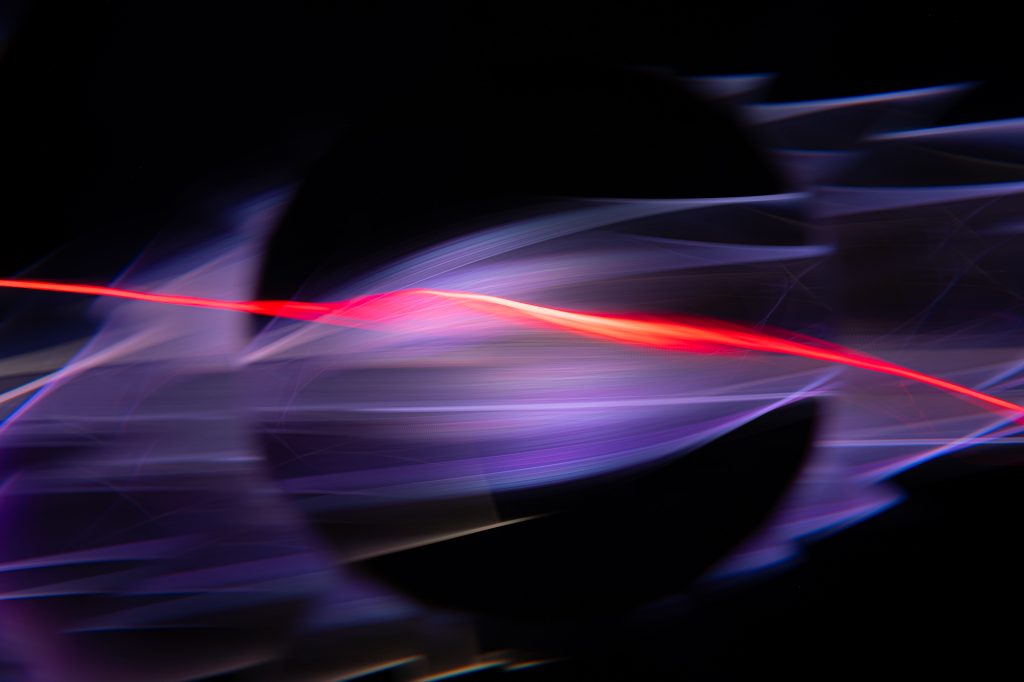
An exemplification of this mechanism is the execution titled The Creation of the Sun and the Moon from the cycle The Song of God the Creator. This work touches upon the moment when, thousands of years ago, the human intellect began to build the first abstract conceptual structures to explain processes that eluded the senses. In the myth from the Book of Genesis, the act of creating celestial bodies is not, in essence, the creation of physical matter, but the establishment of the guardians of time. The movement of these objects provided the primal observer with the only available tool to structure the concept of change and duration. The Sun and the Moon were never the essence of time, but merely its external hands. The key remains that which is completely intangible: the collaborative relation between both bodies and the overarching concept of change. Time in human experience reveals itself as a fluid structure, susceptible to states of consciousness. Its perception lengthens drastically in moments of anticipation or discomfort, proving that mathematical measurement does not exhaust the nature of this phenomenon. Moreover, on a cosmic scale, time undergoes actual modification by gravity—a force devoid of a material carrier, being a pure curvature of spacetime geometry. On the surface of the work, through the autonomous matter of light, this very invisible network of dependencies reveals itself: the gravitational interaction of masses, the dynamics of tides, and the position of the observer themselves inscribed into this physical system.
The greatest weapon against Picasso’s material mark is the absolute placement of art within the domain of thought and philosophy—that is, within non-physical registers. For Hilma af Klint, the starting point was a mysticism rooted in anthroposophy, which undoubtedly marked the correct direction of escape from matter. Conscious Abstraction, however, expands this concept to include every field of human knowledge that operates with theoretical constructs. The role of the artist is redefined. The creator ceases to be merely a person craft-producing objects and debating the definition of art, and their cognitive horizons must encompass significantly broader territories. Conscious Abstraction assumes that art will not take its next evolutionary step unless it carries out a profound renaissance of its own structures. Instead of collapsing into the realm of pure intuition, personal emotions, or repetitive color and compositional schemes, the contemporary creator—following the model of Leonardo da Vinci—must integrate their practice with science, history, and philosophy, examining their structural impact on human consciousness.
The foundations of abstract thinking were not born at the beginning of the twentieth century. They were built over millennia, partly through religion, which was the first to construct a powerful, non-physical concept of a nation. An analysis of biblical texts shows the evolution of this process. The initial myth of Moses consolidated the community around a tribal God, but what emerged from Egypt was not a homogeneous, genetic group bound by blood ties, but a multi-ethnic, multilingual crowd of refugees and slaves. They did not yet know the later concepts of Eden, the flood, or the Messiah. Yet, it was precisely the confrontations with other cultures and disputes on a metaphysical and intellectual level that forced the rapid development of the abstract structures needed to expand the system of religion itself. For example, the Decalogue, which in the older Egyptian culture functioned as a collection of spells from the Book of the Dead or pragmatic advice for officials, was transformed in proto-Israelite culture into a rigorous legal system. In turn, the Book of Genesis adapted the earlier myth of Enuma Elish, turning it into a profound wisdom discussion. Even then, the battle was fought at the level of pure concepts. Since twentieth-century theosophical and anthroposophical movements drew directly from this centuries-old tradition of conceptual analysis, it is precisely there that the true roots of abstract thinking are to be found. This fact was completely misunderstood by Picasso. For him, abstraction was merely a mutation of sensory reality, whereas Conscious Abstraction is an intellectual process describing content unattainable by the figurative apparatus. The material mark has no place here, because Conscious Abstraction grows from an entirely different reality—from the world of thought structures, not from physical matter.
What, then, is authentic abstraction in its essence, if not a precise record of what our intellect perceives, and the direct transfer of these non-physical structures onto the visual surface? However, one must with all firmness separate this process from the so-called non-objective world. Pure non-objectivity, focused solely on the rejection of figuration, remains intellectually empty and decorative, because it carries no conceptual constructions behind it. Conscious Abstraction is not the absence of an object. It is the fullness of thought, a rigorous code, and a sovereign reality in which pure philosophical dogma takes the place of removed matter. Such a complex, non-physical dogma cannot be enclosed within figurative painting, because concepts like Time, Peace, or War cannot be described other than through the relations of other abstractions. An analysis of reality proves that we live in a conceptual world that possesses only a material shell, and the true fabric of our existence consists of structures generated by human consciousness.
Here runs the boundary between illusion and truth. The mark Picasso spoke of does not exist in the world of abstract concepts, because the vector of its origin has completely changed. It is time to finally abandon the perspective of the Spanish master. In the system of Conscious Abstraction, there is no question of an afterimage of a bull or a table, because the physical initial impulse is completely eliminated. Instead, what manifests on the surface is the record of a rigorous thought process and the pure intention of the artist-philosopher, proving that non-physical manifestation does not strip thought of its abstract dogma.
Picasso’s charge of an inevitable figurative core crumbles when confronted with the mechanism of the human symbol itself. When a human uses the heart sign, there is no anatomical truth about the physical organ within its structure. In the contemporary visual code, a change of its color to yellow or blue immediately redefines its entire meaning, shifting it into pure emotional and cultural registers. Exactly the same happens on the surface of the work, where the creative process begins with grounding in other abstract signs, building the description of each concept from elements that are equally intangible.
Visual representation, therefore, is not an afterimage of matter, but a conceptual skeleton in which “eternity” consists of an “infinite period of time,” and each of these elements operates exclusively in relation to another abstraction. Furthermore, this system utilizes conceptual metaphors as natural to the human intellect as spoken language. This allows for the visual embodiment of dogmas based on advanced thought operations, such as the very act of breaking a law. In this concept, a simultaneous collision of two entirely different registers occurs: where purely physical, mechanical dynamics of destruction meet an intangible, conceptual system of norms. The intellect constitutes this collision as a synthesis of matter and pure idea, creating a new conceptual quality. In exactly the same way, Conscious Abstraction operates on the surface, building visual correlations between non-physical systems of meanings.
When we transfer these executions onto the surface, we detach ourselves from matter both in the sphere of figuration and at the level of the concepts themselves. The physicality of the medium becomes merely a necessary carrier for the code. The ultimate work generates itself within the cognitive apparatus of the viewer, who reconstructs a pure, non-physical idea from the elements arranged by the author, proving that art is capable of operating directly on the fabric of human consciousness.
In this system, the work becomes a visual equation that engages Phenomenal Consciousness for pure sensing and Access Consciousness to execute a logical operation—a direct conversation about the world of intangible concepts. This process acts as a rigorous record of conceptual structures. Two original methods serve to realize these assumptions.
The Method of Overexposure (Prześwietlenie) relies on the intellect penetrating existing thought patterns. Conscious Abstraction lays bare the internal structure of a dogma and reaches its philosophical core, eliminating informational noise and entrenched habits of perception.
The Method of Unpacking (Rozpakowanie) denotes the process of the recipient dismantling the physical shell of the record—the transition from visual form to the hidden structure of meaning. The surface engages both intuitive phenomenal experience and the analytical reading of symbols. Only the synthesis of these two spheres allows the viewer to enter the structure of the work and decode it in accordance with the creator’s intention.
Conscious Abstraction is not a path of escape from the object, which would be doomed to failure from the start by our innate memory of matter. It is a tool of an entirely different cognition. The work does not need to sever material roots, because it grew in an entirely different soil. Instead of secondarily processing the physical world, a new, parallel conceptual reality is forged on the surface, embodied through the pure emanation of light.
Instead of the fear of the vacuum that paralyzed Picasso, we receive a manifest describing the world of thought, of abstract dogmas, and even scientific ones. For the first time, art takes up the baton of philosophical consequences. The visual recording of processes such as quantum teleportation is not reduced here to a superficial question of what it would look like to see one’s own doppelgänger. It poses fundamental questions: can the structure of human identity be modified, controlled, and subjected to evolution in this way?